The big freeze has naturally affected the various water-based birds we see in different ways. Now that it is over (for the moment at least) we have mallards back on the moat. They usually appear in late January or early February once again so they are maybe a week or so early. They are in the partnering up phase and the mixture of five drakes and four ducks was bound to lead to some competition. Two drakes were arguing over a female and had a fight using their beaks seeming to try and grab hold of each others beak. It lasted about ten seconds and then a winner was declared who went to swim next to the watching duck.
Not so good for the moorhens. A fox used the ice on the moat covering the snow on top of the ice with tracks. We had seven moorhens - there seem to be only one or two now. All that careful breeding last year has been undone it seems. Hopefully some more will come in from neighbouring ponds to give us two or three breeding pairs in due course.
No sign if the kingfisher for a few months and no sign of the heron for a few weeks. I hope the kingfisher comes back in the spring. If he does I will definitely get a better photograph this time.
Tuesday, 18 January 2011

Sunday, 19 December 2010
More birds and the freeze
The second round of freezing weather has seen me once again feeding the birds and has brought in again some unusual visitors. In the last couple of days there was a buzzard, a green woodpecker and a songthrush. All these species have been in the garden area before but not recently and not often. These were seen from a sum total of ten minutes observation so it is likely there are other 'unusual' species as well. I shall try and have a longer look tomorrow.
Monday, 29 November 2010
Birds and the Big Freeze
When the weather got really cold a few days ago I started putting out some food and water for the birds. They have been coming in to feed in some numbers and it is interesting to watch the interactions between species which are affected of course by the presence of scarce food. There was a wood pigeon today which was feeding on seed I had put on the low well wall. A moorhen arrived and started feeding and the pigeon stopped eating and seemed to be staring. Two more moorhens arrived and moved nearer the pigeon. At that point it flapped its wings and the moorhens backed down and left. Meanwhile a moorhen was on the grass surrounded by fifteen or so pigeons started taking a liitle run at individual pigeons each of whom backed away. So one pigeon beats three moorhens and one moorhen beats fifteen pigeons. Go figure.
The weather also brought in a sparrowhawk which was the first time I have seen a sparrowhawk perched in the garden and also a partridge which I think was a grey partridge. My id was not certain so I can't count it as a new species. Apart from that it was the usual suspects various tits, blackbirds, dunnocks, chaffinches and robins plus some distant commotion as the resident crows chased off the heron.
The weather also brought in a sparrowhawk which was the first time I have seen a sparrowhawk perched in the garden and also a partridge which I think was a grey partridge. My id was not certain so I can't count it as a new species. Apart from that it was the usual suspects various tits, blackbirds, dunnocks, chaffinches and robins plus some distant commotion as the resident crows chased off the heron.
Saturday, 23 October 2010
2-Spot Ladybird - black form

I see a fair number of 2-spot ladybirds and have done for years. Today however was the first time I have seen the 'black' form. I have no idea how common the black form is overall but based on the last six years it is remarkably uncommon on this site.
It has been a good year for the 2-spot and the 7-spot ladybird this year. It was also OK last year but in 2008 they were less common. The only other species I have seen this year is the 14-spot and the Harlequin. In 2005 I saw the 2,7 and 14-spot and in addition the Orange Ladybird and the Eyed Ladybird. I am not sure whether their apparent absence since 2005 is natural variation in the populations, just chance as regards observation or some kind of effect of the invasive Harlequin Ladybird.
Monday, 18 October 2010
New Species - Grey Shoulder Knot

I found a moth resting on our back door when returning after a night away. I was bit daunted at first as there seemed to be lots of medium sized grey moths but I have finally identified it as a Grey Shoulder Knot (Lithophane ornitopus). Now I have identified a few moths I am encouraged to get a moth trap and really start on the many moths that inhabit the site.
Thursday, 14 October 2010
New Species - Lesser Marsh Grasshopper
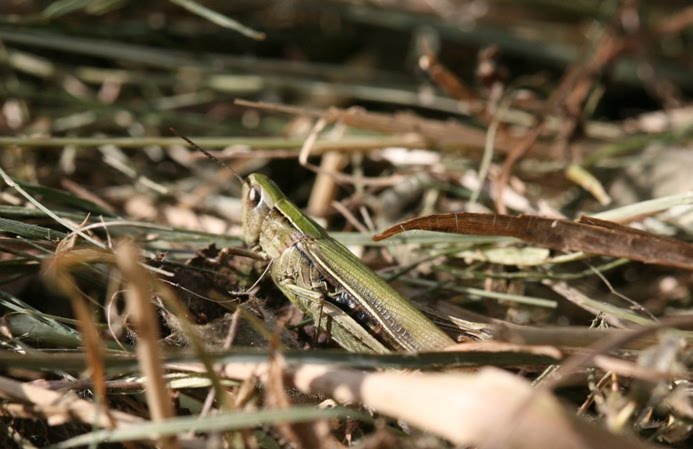
In August I took some pictures of a couple of grasshoppers. I had seen grasshoppers and crickets before but had struggled to photograph and ID them. I also struggled to identify the first one from my photograph - mainly because it didn't seem to fit with the ones in my insect book. I had another go today and in fact it wasn't in the book at all but seems to be a Lesser Marsh Grasshopper (Chorthippus albomarginatus)with a distinctive white line along its wing. The other grasshopper is a brown form of the same species as opposed to the green form shown above.
Saturday, 9 October 2010
Grass snake picture at last

Although I see grass snakes reasonably regularly I have never managed to get a photograph (apart from one effort that was so blurred the snake looked like a twig). I was thinking the other day that I hadn't had a sighting recently but yesterday I had two excellent sightings. The first was in the moat where I normally see them but the second one was half way between the compost heap and the moat. Given that I have put a lot of effort into building a giant compost heap for the snakes to breed and hibernate in, I will take this as evidence that they are aware of it and will be using it shortly. At my approach the snake stopped and that gave me an opportunity to get a picture albeit with an unsuitable lens in gloomy conditions.
Subscribe to:
Posts (Atom)