When the weather got really cold a few days ago I started putting out some food and water for the birds. They have been coming in to feed in some numbers and it is interesting to watch the interactions between species which are affected of course by the presence of scarce food. There was a wood pigeon today which was feeding on seed I had put on the low well wall. A moorhen arrived and started feeding and the pigeon stopped eating and seemed to be staring. Two more moorhens arrived and moved nearer the pigeon. At that point it flapped its wings and the moorhens backed down and left. Meanwhile a moorhen was on the grass surrounded by fifteen or so pigeons started taking a liitle run at individual pigeons each of whom backed away. So one pigeon beats three moorhens and one moorhen beats fifteen pigeons. Go figure.
The weather also brought in a sparrowhawk which was the first time I have seen a sparrowhawk perched in the garden and also a partridge which I think was a grey partridge. My id was not certain so I can't count it as a new species. Apart from that it was the usual suspects various tits, blackbirds, dunnocks, chaffinches and robins plus some distant commotion as the resident crows chased off the heron.
Monday, 29 November 2010

Saturday, 23 October 2010
2-Spot Ladybird - black form

I see a fair number of 2-spot ladybirds and have done for years. Today however was the first time I have seen the 'black' form. I have no idea how common the black form is overall but based on the last six years it is remarkably uncommon on this site.
It has been a good year for the 2-spot and the 7-spot ladybird this year. It was also OK last year but in 2008 they were less common. The only other species I have seen this year is the 14-spot and the Harlequin. In 2005 I saw the 2,7 and 14-spot and in addition the Orange Ladybird and the Eyed Ladybird. I am not sure whether their apparent absence since 2005 is natural variation in the populations, just chance as regards observation or some kind of effect of the invasive Harlequin Ladybird.
Monday, 18 October 2010
New Species - Grey Shoulder Knot

I found a moth resting on our back door when returning after a night away. I was bit daunted at first as there seemed to be lots of medium sized grey moths but I have finally identified it as a Grey Shoulder Knot (Lithophane ornitopus). Now I have identified a few moths I am encouraged to get a moth trap and really start on the many moths that inhabit the site.
Thursday, 14 October 2010
New Species - Lesser Marsh Grasshopper
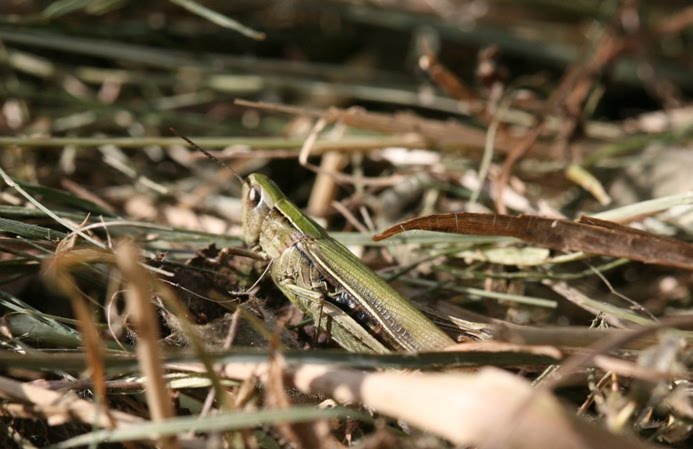
In August I took some pictures of a couple of grasshoppers. I had seen grasshoppers and crickets before but had struggled to photograph and ID them. I also struggled to identify the first one from my photograph - mainly because it didn't seem to fit with the ones in my insect book. I had another go today and in fact it wasn't in the book at all but seems to be a Lesser Marsh Grasshopper (Chorthippus albomarginatus)with a distinctive white line along its wing. The other grasshopper is a brown form of the same species as opposed to the green form shown above.
Saturday, 9 October 2010
Grass snake picture at last

Although I see grass snakes reasonably regularly I have never managed to get a photograph (apart from one effort that was so blurred the snake looked like a twig). I was thinking the other day that I hadn't had a sighting recently but yesterday I had two excellent sightings. The first was in the moat where I normally see them but the second one was half way between the compost heap and the moat. Given that I have put a lot of effort into building a giant compost heap for the snakes to breed and hibernate in, I will take this as evidence that they are aware of it and will be using it shortly. At my approach the snake stopped and that gave me an opportunity to get a picture albeit with an unsuitable lens in gloomy conditions.
Thursday, 30 September 2010
Meadow flora

My attempt at recording flower species in the meadow was partially successful. I did record 21 species of flower but I also recognise that there were a number I didn't get round to positively identifying so there is still some scope for increasing this list significantly next year. I also identified three species of grass and this is definitely only a partial record. I find grasses quite challenging to id but I have a new book by Francis Rose that is going to help me expand that list next time round. For the record the 21 species of flower are White Dead Nettle, Garlic Mustard, Meadow Buttercup, Ribwort Plantain, Cow Parsley, Common Sorrel, Stinging Nettle, Scented Mayweed, Broad-leaved Dock, Red Clover, Self Heal, Common Knapweed, Common Mouse-ear, White Clover, Ox-eye Daisy, Yarrow, Common Ragwort, Creeping Thistle, Scentless Mayweed, Bird's Foot Trefoil and Greater Plantain. The three grasses I identified were Cocksfoot, Timothy and Perrenial Rye Grass. The picture is of a patch of Scented Mayweed - one of the commoner flowers in the meadow..
Thursday, 23 September 2010
Common Darter
There have been some Common Darters flying over the last few days. No pictures yet but I shall try and snap one if we have any more sunny days. It's been a very good year for dragonflies with seven confirmed species. For the record they are Southern Hawker, Emperor Dragonfly, Blue-Tailed Damselfly, Large Red Damselfly, Azure Damselfly, Broad-Bodied Chaser and Common Darter. If I get time I shall trawl through my photos of Azure Damselflies to see if any are in fact Common Blue Damselflies just to see if I can make it eight species.
Subscribe to:
Posts (Atom)